


Updated · 5 min read
The short answer. Carrier pay is what you pay the carrier. The broker fee is the customer total minus carrier pay, and it is the only part of the move that is yours: $550 from the customer with $450 to the carrier leaves a $100 fee. Store both as separate fields and calculate the fee, so a raise in carrier pay shows up as lost margin when it is agreed.
Two numbers decide whether a load made money. Most brokerages track one of them properly and reconstruct the other from memory.
1. The two numbers
On any brokered vehicle move there are two figures that matter:
- Customer total — what the customer agrees to pay you.
- Carrier pay — what you agree to pay the carrier who physically moves the car.
The difference is your broker fee, and it is the only part of the transaction that is yours. On a $550 customer total with $450 going to the carrier, your fee is $100. The brokerage does not run on the $550. It runs on the $100.
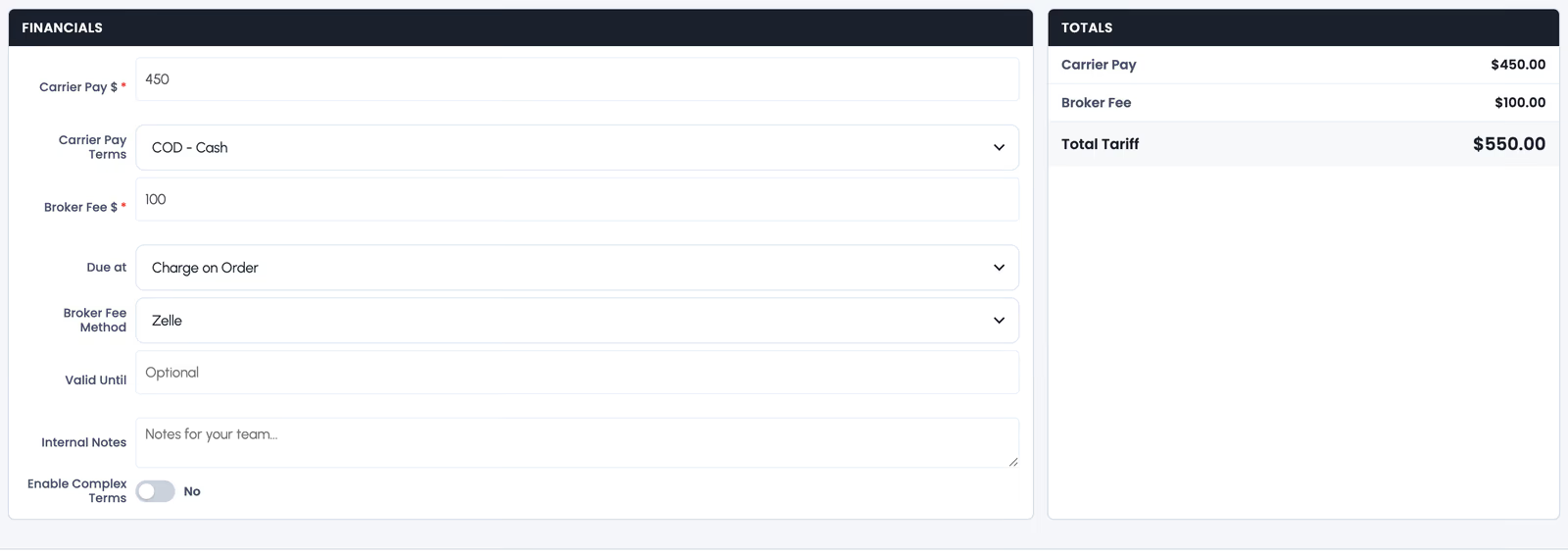
2. Why one combined price hides the problem
Plenty of brokerages track the customer total carefully — it is the number on the invoice, so it is hard to lose — and treat carrier pay as a detail settled later, in a text message, at dispatch time.
That ordering is the problem. The fee is set at quote time, but the carrier pay is agreed hours or days afterwards, often by a different person, under time pressure, when the car needs to move today. Nobody is looking at the original margin at the moment the decision that destroys it gets made.
If your system stores a single "price" field, there is no margin to look at. It has to be reconstructed by opening the invoice, finding the dispatch, and subtracting. Nobody does that on a Tuesday afternoon with eleven cars to place.
3. Where the margin actually leaks
In roughly the order they cost the most:
- Raising carrier pay to fill an aging load. Entirely legitimate — an empty slot earns nothing. The failure is not knowing that a $100 fee just became $40 as you agreed it.
- Quoting from a stale rate. Lanes move. A price that was healthy six weeks ago can be underwater today, and a quote template does not know that.
- Absorbing changes. Inoperable vehicle, gate fee, a second attempted pickup. Small, frequent, and rarely re-quoted.
- Discounting to close. Visible and usually deliberate. Cheapest of the four precisely because everyone notices it.
Only the last is normally treated as a margin decision. The first three are treated as operations, and they are where the money goes.
One more sits outside that list, because nobody decides it at all: card processing comes out of your fee, not out of the total. Stripe's published US rate is 2.9% plus 30¢ per card payment. If the customer pays the full $550 through you, that is $16.25 — charged on the whole total, paid entirely from your $100, and 16% of the margin gone before anyone touched carrier pay. If the customer pays only the $100 deposit by card and the carrier collects the balance on delivery, it is $3.20.
Same load, same fee, five times the processing cost, decided by payment terms that were probably never discussed as a margin question. We priced processing against the rest of a brokerage's costs in our breakdown of what auto transport broker software really costs.
4. What to record on every order
Whatever you use, hold these as separate fields on the same record:
- Customer total
- Carrier pay, as quoted and as finally agreed
- Broker fee, derived from the two — never typed by hand
- Who changed carrier pay, and when
- Deposit taken and balance outstanding
The derived fee is the important one. If someone can type a fee independently of the two numbers it comes from, it will eventually disagree with them, and you will not know which is right.
"As quoted and as finally agreed" is the second. Keeping both is what turns raised carrier pay from an invisible event into a number you can total at the end of the month.
5. The reports this makes possible
Once the two numbers are separate and the fee is derived, several questions stop being guesswork:
- Average broker fee per order, this month against last.
- Fee by lane — which routes are worth quoting and which are volume without profit.
- Fee by agent, which is a coaching conversation rather than an accusation once the data exists.
- Fee by lead source, so you can see what your marketing actually returns rather than how many leads it produced.
- Total given away in raised carrier pay, which is usually the number that surprises people most.
None of this needs a data analyst. It needs the two figures stored separately at the moment each is agreed.
TruxCRM keeps customer total and carrier pay as distinct fields on the shipment record and derives the fee from them, so margin is visible on the order rather than assembled afterwards. If you want to see that against your own numbers, book a walkthrough — or read what else is on the record on the features page. If you are weighing platforms, our auto transport CRM comparison notes which ones keep broker fee and carrier pay as separate fields.
6. Frequently asked questions
What is the difference between broker fee and carrier pay?
Carrier pay is what you pay the carrier who physically moves the vehicle. The broker fee is the customer total minus carrier pay, and it is the only part of the transaction that is yours. On a $550 customer total with $450 to the carrier, the broker fee is $100.
Should the broker fee be typed in or calculated?
Calculated, always. Store customer total and carrier pay as separate fields and derive the fee from them. A fee that can be typed independently will eventually disagree with the two numbers it comes from, and there is no way to tell which one is right.
Where does an auto transport brokerage lose margin?
Mostly in decisions treated as operations: raising carrier pay to fill an aging load, quoting from a stale rate, and absorbing small changes such as an inoperable vehicle or a second pickup attempt. Discounting to close is the one everyone notices, and it usually costs the least. Card processing takes a share of the fee on every card payment too.
Does card processing come out of the broker fee?
Yes, if the customer pays you by card, because carrier pay is fixed and the processor charges on whatever amount you take. At 2.9% plus 30¢, taking the full $550 by card costs $16.25 of a $100 fee; taking only a $100 deposit by card, with the balance paid to the carrier on delivery, costs $3.20.