


Updated · 10 min read
The short answer. Verify authority and insurance in FMCSA's own records, not in the documents the carrier sends, and check that the phone and address on file match. Confirm liability cover meets the $750,000 federal minimum, then read the cargo policy separately, because the federal cargo minimum is suspended. Check again on pickup day.
A car hauler can hold valid federal authority, pass every check you know how to run, and still carry nothing at all on the vehicle it is about to load.
1. What you are actually checking for
Vetting a carrier is usually described as a compliance chore. It is not. You are answering three separate questions, and they fail in different ways:
- Is this company real, and is it allowed to haul? A question about federal authority, and the easiest of the three to answer properly.
- If they destroy the car, who pays? A question about insurance, and the one most brokers get wrong — see sections 3 and 4.
- Is the truck that shows up the company I hired? A question about double brokering, and the only one that cannot be settled before dispatch.
A checklist that treats these as one step tends to answer the first, assume the second, and never ask the third.
2. Authority: check the source, not the paperwork
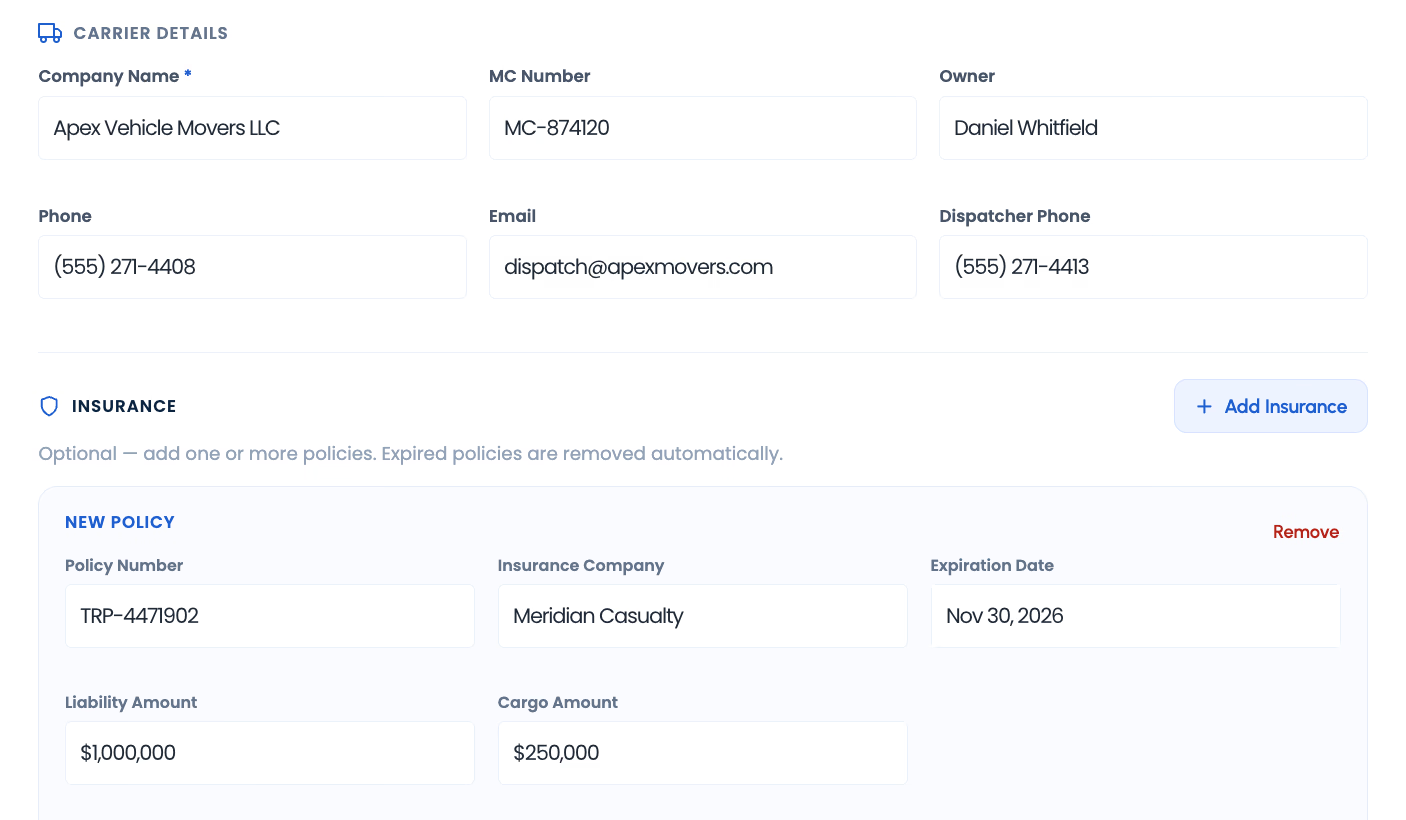
Collect the legal name and DBA, the USDOT and MC numbers, a W-9, the certificate of insurance, the address and phone FMCSA has on file, dispatcher and driver contacts, and the equipment type. That is the intake. It is not the verification.
The verification is done against FMCSA's own systems, not against what the carrier emailed you:
- SAFER Company Snapshot — search by USDOT or MC number. Confirm the operating status is active and the authority covers property for hire.
- FMCSA Licensing & Insurance (L&I) — the insurance filings themselves, including cancellations.
- Cross-check the contact details. The phone and address in SAFER should match what the carrier gave you. A mismatch is the single most common sign of a hijacked MC number.
That last point does most of the work. Identity theft in this industry rarely involves inventing a company — it involves borrowing a real one with a clean record, then routing the phone number and email to somebody else. The record looks perfect because it is perfect. It just is not the company you are talking to.
3. The liability number is $750,000, and it is not cargo
You will see $1,000,000 quoted constantly as the federal minimum for car haulers. It is wrong, and the error matters because it makes people stop checking once they see a big number on a certificate.
The actual schedule is in 49 CFR § 387.9. For non-hazardous property moved for hire in a vehicle rated over 10,001 pounds, the minimum is $750,000. The $1,000,000 tier applies to oil and hazardous materials. There is no entry in that schedule specific to transporting motor vehicles at all.
More importantly, that figure is public liability — bodily injury and property damage the truck causes to other people. It is not coverage on the car sitting on the trailer. Those are different policies, and only one of them is federally mandated.
4. The cargo gap that is specific to car hauling
Here is the part that catches auto transport brokers specifically, because cargo damage is the claim type in this business. A scratched or dented vehicle is the normal failure, not a highway accident.
The federal cargo insurance minimums live in 49 CFR § 387.303. That section has been suspended indefinitely since September 2019. The regulation text carries the note itself: suspended in January 2017, briefly lifted in September 2019, then suspended again in the same document.
The practical consequence: FMCSA is not verifying cargo coverage for you, and a carrier with entirely valid authority may carry little of it, or none. Cargo coverage is a commercial matter between you, the carrier, and your customer — not a box the federal government ticks on your behalf.
So the check is not "are they insured". It is:
- Is there a cargo policy at all, separate from the liability policy?
- What is the limit, and does it cover a full load rather than one car? A nine-car trailer of late-model vehicles can exceed a $100,000 cargo limit without trying.
- What is the deductible, and who absorbs it? This decides who pays for the common small claim.
- Are inoperable vehicles, or the top deck, excluded? Exclusions are where a policy that exists still does not pay.
None of that appears in SAFER. You have to read the policy, and a certificate summarising it is not the policy.
5. What double brokering looks like from your desk
Double brokering is a load you assigned being quietly handed to somebody else. Sometimes the second party actually moves the car for less. Sometimes nobody moves it and the money is gone. Either way you have paid a company that never touched the vehicle, and your cargo claim is against a carrier whose policy does not cover a load it never legally held.
Re-brokering without broker authority and a bond is not a grey area. Brokering requires registration and financial security under 49 CFR § 387.307 — $75,000 for a broker, and since the compliance date of 16 January 2026 the enforcement around it is materially tighter. A surety must now notify FMCSA within two business days of a drawdown, and the agency will move to suspend operating authority within seven business days of notice unless the broker restores the security.
The signals, in the order they usually appear:
- The rate is too good. A carrier accepting well below market on a lane nobody wants is the oldest tell there is.
- Pressure to dispatch before paperwork. Urgency is the mechanism. Every fraud in this category needs you to skip a step.
- The driver's name never matches. Ask who is driving and what unit before dispatch, then check it at pickup.
- Payment details that arrive separately. Banking instructions by email, changed at the last minute, from an address one character off the real one.
- Very new authority, or authority that recently changed hands. Not disqualifying on its own — every legitimate carrier was new once — but it is the profile these schemes select for.
The only check that catches it at the moment it happens is confirming the driver and the unit at pickup against what you dispatched. Everything else is done hours earlier, against a company that was still telling the truth at the time.
6. Valid at onboarding is not valid on pickup day
This is the failure that hurts good brokerages rather than careless ones. You vet a carrier properly in March, they become a regular, and in September their policy lapses. Nothing in your process is designed to notice, because vetting was filed as a one-time onboarding task.
Authority gets revoked. Policies get cancelled mid-term for non-payment. Insurance that was real when you onboarded is a statement about March, and the car moves in September.
Re-verify authority and insurance on a fixed cycle — ninety days is the common practice — and again before dispatch on anything high value. The question that matters is never "did we vet them". It is "was this carrier authorised and insured on the day this specific car moved", and that is a question about a date, which means it is a question about a record.
7. Where the vetting has to live
Most brokerages do more vetting than they can prove. The checks happen — someone pulls up SAFER, someone reads the certificate — and the evidence ends up in an inbox, a shared drive, or nowhere. Six months later, with a damage claim open, the work is indistinguishable from never having done it.
The output of vetting belongs on the shipment, not in a folder about the carrier:
- The carrier assigned to this order, with their MC and USDOT numbers.
- The certificate of insurance as an attachment on the order it was checked for.
- The driver and unit actually dispatched, recorded before pickup rather than remembered after.
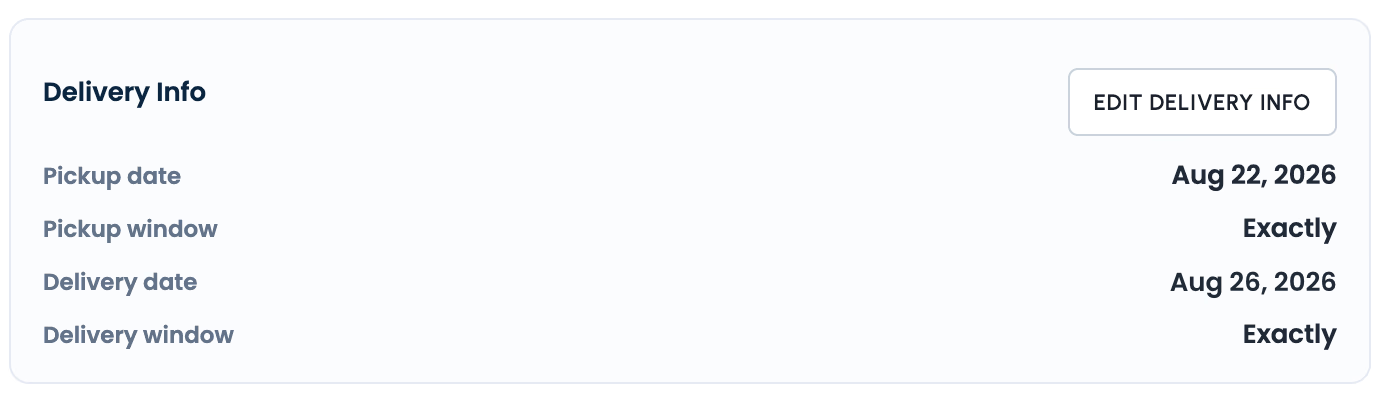
- Dispatch, pickup and delivery dates, so coverage can be tested against the day it needed to be valid.
- A change log — who assigned the carrier, who altered pay, and when.
TruxCRM keeps carrier assignment, driver and insurance detail, the dispatch and delivery timeline, file attachments and a change log on the same order record as the quote and the signature. That does not vet a carrier for you — nothing does, and any vendor claiming otherwise is selling you a database lookup you can run free on SAFER. What it does is make the vetting you already perform provable on the day someone disputes it. The same goes for carriers you find through Central Dispatch: TruxCRM is an official Central Dispatch partner, so you can search Central Dispatch and post loads from the order, but a carrier found there still needs every check above before it gets the car.
If you want to see that against your own dispatch process, book a walkthrough. If you are still choosing a platform, our buyer's guide has eight questions that work on any vendor, including us, and our comparison of the best auto transport CRM software for brokerages shows where each one keeps carrier insurance and what it costs at your headcount.
8. Frequently asked questions
How much insurance does a car hauler legally need?
The federal minimum under 49 CFR § 387.9 is $750,000 of public liability for non-hazardous property carried for hire in a vehicle rated over 10,001 pounds. The often-quoted $1,000,000 applies to oil and hazardous materials. Liability covers damage the truck does to other people; it is not coverage on the cars being hauled.
Is cargo insurance federally required for auto transport carriers?
Not in practice. The federal cargo minimums in 49 CFR § 387.303 have been suspended indefinitely since 30 September 2019, so FMCSA does not verify cargo coverage for you. Check the policy itself: that it exists separately from liability, that its limit covers a full load, what the deductible is, and whether inoperable vehicles or the top deck are excluded.
How do I check a carrier's authority?
Search the USDOT or MC number on FMCSA's SAFER Company Snapshot and confirm the operating status is active and covers property for hire, then check the insurance filings on FMCSA Licensing & Insurance. Compare the phone number and address on record with what the carrier gave you; a mismatch is the most common sign of a hijacked MC number.
Did the freight broker bond go up to $150,000?
No. It is still $75,000. What changed on 16 January 2026 is enforcement: a surety must notify FMCSA within two business days of a drawdown, and authority can be suspended within seven business days unless the security is restored. The rules on what a BMC-85 trust may hold were tightened at the same time.
How often should a broker re-verify a carrier?
On a fixed cycle — ninety days is common practice — and again before dispatch on anything high value. Policies are cancelled mid-term and authority is revoked, so the question is whether the carrier was authorised and insured on the day the car moved, not on the day it was onboarded.